



 Published: August 18, 2026
Managed IT providers—local and national—solve the same core problem: keeping your systems running. But what happens when something breaks at 2 a.m. can look very different depending on which one a Minnesota business hires.
Table of Contents
Key Takeaways
- A national managed IT provider routes your after-hours ticket through a call center. That center is often in a different time zone. A local Minnesota provider’s escalation path is shorter by design.
- Minnesota businesses face state-specific compliance exposure. HIPAA applies to clinics, PCI to retail, CMMC to defense contractors. A generic national playbook doesn’t always account for that.
- On-site response time is the single biggest practical difference. A Minnesota-based provider can have a technician on-site same-day. A national provider dispatches a subcontractor, which adds a layer and a delay.
- Account continuity differs sharply. Local providers typically assign a small, consistent team. National providers route tickets to whichever technician is available that shift.
- The right choice depends less on brand size than on how fast help actually arrives, and how well that help already understands your setup.
What This Comparison Covers
Minnesota businesses evaluating managed IT support usually get pitched by both types of providers. One is a national brand with a recognizable name.
The other is a local Minnesota firm that knows the Minnesota market. This guide breaks down where they actually differ: response time, compliance familiarity, account continuity, and what “local” changes in practice.
The choice shouldn’t come down to which sales rep called first.
Response Time: Who Actually Shows Up
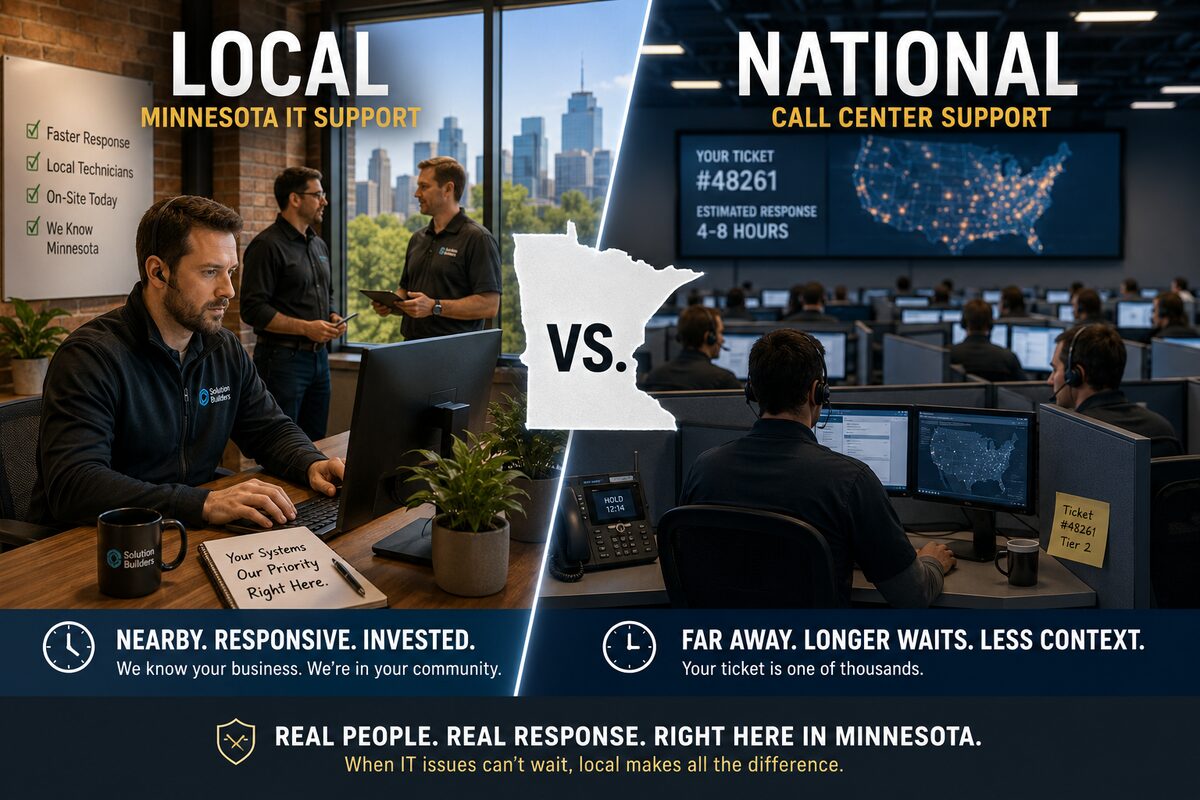
National providers typically staff a centralized help desk. Tickets get triaged by severity, not by location. A Minnesota business calling in after a server goes down waits in the same queue as a client in another state. The technician who picks up the ticket may be working from a script, with no direct knowledge of that business’s network or history.
Local Minnesota-based providers route the ticket differently. It goes to a technician who already knows the client’s environment, and that technician can be on-site in Minnesota the same day. That difference matters most in the moments that actually cost money: a point-of-sale system down during business hours, a server outage during a compliance audit, or a ransomware alert that needs eyes on the actual hardware, not just a remote diagnostic.
The practical test for any provider, local or national, is the same. Ask exactly who shows up, how fast, and whether that commitment is written into the service agreement, not just promised on a sales call.
Compliance Familiarity: Generic Playbook vs. Minnesota-Specific Exposure
A national provider’s compliance documentation is often built for the broadest common denominator. It uses generic HIPAA or PCI language meant to apply everywhere the company operates. That approach isn’t wrong, but it can miss details that only come from working inside one state’s regulatory environment.
A Minnesota-based provider is more likely to have already addressed state-specific considerations. These come up repeatedly for local clients: healthcare network requirements for Minnesota clinics, data-handling expectations tied to Minnesota’s breach-notification rules, and documentation standards for Minnesota government and education vendors.
This familiarity doesn’t replace a business’s own legal counsel—compliance requirements should always be confirmed against current state and federal law with a qualified attorney. For a starting reference, the U.S. Department of Health and Human Services publishes the current HIPAA rules. But day-to-day familiarity with how requirements actually show up for Minnesota businesses can shorten the distance between “compliant on paper” and “compliant in practice.”
For businesses in regulated industries—healthcare, finance, defense contracting, education—this familiarity gap is often the real dividing line between providers. It matters more than brand size or marketing budget.
Account Continuity: Dedicated Contact vs. Rotating Support
With a national provider, the technician who answers today’s ticket is rarely the same one who answered last month’s. Each new ticket often starts the same way: re-explaining the setup, what hardware is in place, what’s been tried before, what’s unique about this business’s network.
With a local Minnesota managed IT provider, the same small team typically manages the account over time. That team accumulates specific knowledge: which server has needed extra attention, which vendor integration is fragile, which employees need extra security awareness support. That institutional memory doesn’t show up on a feature comparison chart. But it’s often the difference between a five-minute fix and a two-hour diagnostic that starts from zero.
Businesses that have experienced high technician turnover with a national provider often describe the same frustration. They re-explain their environment to a new voice every time they call.
What “Local” Actually Changes in Minnesota
For a Minnesota business, “local” isn’t just a marketing word. It changes what’s physically possible. A same-day, on-site visit in the Minneapolis–St. Paul metro is a realistic service-level expectation with a Minnesota-based provider, because the technician is already in the market.
That same commitment from a national provider usually means dispatching a regional subcontractor. That adds both a handoff and a delay, and brings in someone who wasn’t part of the original account relationship.
There’s also a resource-availability angle specific to Minnesota winters. Extreme cold and severe weather events can affect building access, power stability, and travel time for on-site visits. A Minnesota-based provider plans around those seasonal realities as a matter of course. A national provider’s standard playbook may not.
Businesses in Minnesota weighing this decision should ask any provider directly: who is physically driving to this office, and how long does that realistically take, especially outside of ideal weather and traffic conditions?
Questions to Ask Before Signing With Either Type of Provider
These questions apply regardless of which type of provider a Minnesota business is considering. The honest answers usually reveal more than the sales pitch does.
Who answers the phone after hours? Ask specifically whether after-hours calls go to a centralized call center or to someone already familiar with the account. A vague answer here is itself informative.
What’s the guaranteed on-site response time for this location? Get a specific, written commitment. Not “we’ll get someone out as soon as possible”—a stated response window tied to the service agreement.
Does the provider have documented experience with this business’s specific compliance requirements? A provider should be able to point to prior work in the relevant industry, not just a general compliance statement.
Will the same team manage this account over time, or will support rotate? This single question often separates providers more clearly than any feature list.
What’s at Stake in the Decision
The cost of getting this wrong can cost your business. A slower after-hours escalation path can turn a one-hour outage into a half-day one. Every hour of downtime means lost revenue and lost productivity.
A generic compliance approach can miss a Minnesota-specific requirement until a client, an auditor, or a regulator finds it. At that point, the fix costs far more than the prevention would have. And a rotating support team means every incident starts partway back at zero, re-explaining a setup that a consistent local team would already know.
For a Minnesota business, the managed IT provider decision comes down to two things: how fast real help arrives when something breaks, and how well that help already understands the business before the call comes in.
About Solution Builders
At Solution Builders, we have provided managed IT services for over 30 years. The company is based in Bloomington, Minnesota, and serves the Minnesota metro directly. Contact us to speak directly with a representative who can help you switch to local managed IT.
Talk to a Managed IT Provider Based in Minnesota
If you’re comparing local and national managed IT support for a Minnesota business, Solution Builders can walk through your specific setup and what a Minnesota-based response time actually looks like in practice. Call 612-787-7678 for a free consultation.