




 Published: December 15, 2025
Choosing a Managed Service Provider (MSP) is a strategic business decision that directly impacts security, daily operations, costs, and your ability to scale. This IT Services Buyers Guide breaks the selection process into five focused chapters, giving CFOs and office managers a clear, structured way to evaluate providers, compare options objectively, and establish the foundation for a successful long-term partnership.
To help with your decision-making process, also check out our 3rd-party analysis of the Top Managed Service Providers in Minneapolis.
Table of Contents
How to Use This IT Services Buyers Guide
This IT Services Buyers Guide is designed to be both a decision framework and a practical evaluation tool. Each chapter can be reviewed independently, but the greatest value comes from using the scoring criteria, checklists, and milestone plans together to compare MSPs side by side.
For leadership teams, this guide supports objective decision-making by replacing subjective opinions with documented criteria, measurable outcomes, and evidence-based evaluation. For finance and operations leaders, it provides visibility into cost drivers, risk exposure, and expected return on IT investments over time.
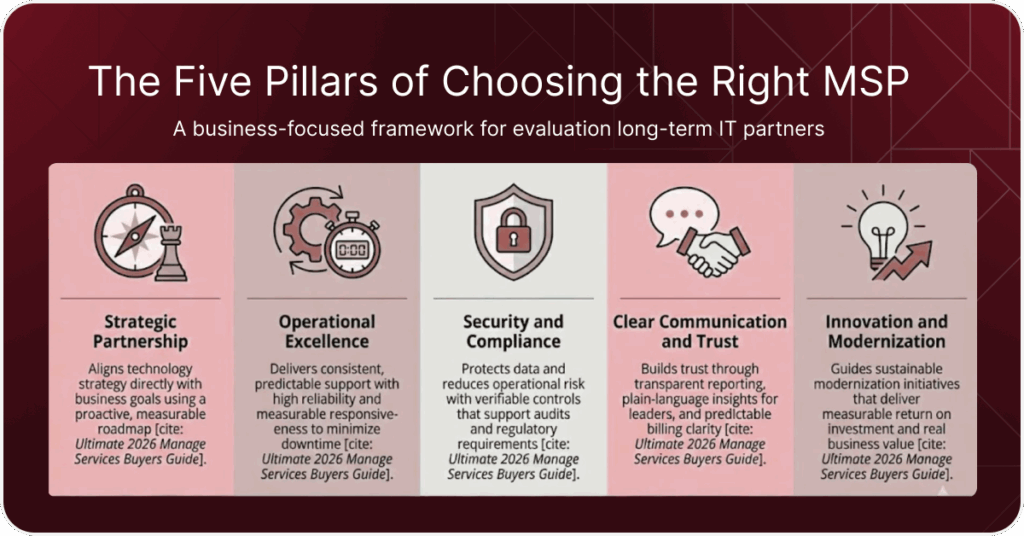
Strategic Partnership
Why your MSP must operate like a virtual CIO and how to validate strategic alignment.
For most organizations, technology decisions increasingly influence revenue, risk, efficiency, and employee experience. An MSP that only reacts to tickets and outages leaves leadership making technology decisions in the dark. A true strategic MSP operates as a virtual CIO, proactively advising on priorities, translating business goals into technology strategy, and helping leadership understand tradeoffs between cost, risk, and growth. Strategic alignment ensures technology spending is intentional, measurable, and directly tied to where the business is headed rather than where problems arise.
Purpose and outcome
Goal: Ensure your MSP helps prioritize technology investments that advance business objectives, not just resolve day-to-day issues.
Outcome: A 12 to 36 month technology roadmap aligned to measurable business outcomes such as reduced operating costs, improved uptime, faster onboarding, or risk reduction.
What to look for during evaluation
- Business-first planning: Evidence of a discovery process that incorporates financial goals, operational needs, and growth plans.
- Roadmap deliverables: A written roadmap with timelines, cost ranges, and measurable milestones.
- C-suite communication: The ability to explain technical decisions in plain business terms suitable for CFOs and leadership teams.
- Vendor strategy: A clear, proactive approach to managing third-party vendors and optimizing licensing.
Questions to ask prospective MSPs
- How do you translate our business goals into a technology roadmap?
- Can you share examples of roadmaps you’ve built for similar organizations?
- How frequently do you review and update the roadmap with leadership?
Scoring (0–3 per item)
- Discovery depth: 0 = none; 1 = basic; 2 = thorough; 3 = tailored and documented.
- Roadmap quality: 0 = none; 1 = generic; 2 = specific; 3 = business-aligned and costed.
- Executive communication: 0 = none; 1 = occasional; 2 = regular; 3 = structured briefings.
First 90-day implementation milestone plan
- Weeks 1–2: Business discovery and full systems inventory.
- Weeks 3–4: Risk and technology spend snapshot.
- Weeks 5–8: Draft roadmap and prioritized quick-win list.
- Weeks 9–12: Finalize roadmap, agree on KPIs, and begin the first quick-win initiative.
Operational Excellence
How to measure responsiveness, reliability, and accountability.
Operational excellence is where MSP promises are either proven or exposed. While strategy sets direction, day-to-day operations determine whether employees stay productive, systems remain available, and leadership can trust IT as a dependable function rather than a constant source of friction. Measuring responsiveness, reliability, and accountability ensures your MSP is not just present when problems occur, but consistently delivering predictable, high-quality service that aligns with business expectations.
Core components and why they matter
- Helpdesk responsiveness: Minimizes downtime and protects employee productivity.
- Proactive monitoring and remediation: Prevents incidents before they impact users.
- Patch and lifecycle management: Reduces security exposure and avoids unplanned replacement costs.
- Transparent reporting: Supports budgeting, forecasting, and vendor accountability.
Key metrics to require in an SLA or evaluation
- Ticket response time: Initial response within defined minutes or hours.
- Resolution time: Mean time to resolution by ticket priority.
- System availability: Uptime percentage for mission-critical systems.
- Patch coverage: Percentage of devices patched within defined timeframes.
- Backup and restore objectives: Clearly defined RTO (Recovery Time Objective) and RPO (Recovery Point Objective).
Sample SLA targets to start with
- Priority 1: Initial response in 15–30 minutes; resolution target of 4–8 hours.
- Priority 2: Initial response within 1 hour; resolution within 1–2 business days.
- System availability: 99.9% uptime for critical services.
- Patch windows: Critical patches within 7 days; routine updates within 30 days.
Operational evaluation checklist
- Do they provide a 24/7 NOC or a clearly defined after-hours support process?
- Can they demonstrate monitoring dashboards with historical performance data?
- Are maintenance windows automated, scheduled, and clearly communicated?
- Do they include lifecycle planning and hardware replacement schedules?
Red flags
- Vague, missing, or unenforced SLAs.
- No evidence of proactive monitoring or remediation.
- Reporting that is inconsistent or only provided upon request.
Security and Compliance
How to confirm your MSP protects data, reduces risk, and supports audits
Security and compliance are no longer purely technical concerns—they are core business risks. A single breach, failed audit, or prolonged outage can result in financial loss, regulatory penalties, reputational damage, and executive accountability. This section helps leadership move beyond vague assurances and marketing claims to validate, with evidence, that an MSP has the processes, controls, and discipline required to protect sensitive data, reduce operational and cyber risk, and support audits with confidence. A strong MSP should make security posture visible, measurable, and defensible at the executive level.
Core security and compliance responsibilities
- Ongoing risk assessments with documented remediation plans.
- Endpoint protection, patch management, and regular backup validation.
- Identity and access management, including MFA and least-privilege enforcement.
- Policies and documentation to support audits and regulatory requirements.
Must-have deliverables from a compliance-ready MSP
- Written security policies and a documented incident response plan.
- Evidence of regular vulnerability scans and remediation logs.
- Backup testing records and documented restore procedures.
- Role-based access reviews and a formal offboarding checklist.
Review and validation questions
- Which frameworks or standards do you follow (NIST, CIS, ISO), and how are controls mapped to our environment?
- Can you provide summaries from recent third-party penetration tests or vulnerability scans?
- How do you validate backup integrity and demonstrate restore capability?
- What are your incident response steps, and how is leadership notified?
KPIs and compliance checkpoints
- Vulnerability remediation rate: Percentage of high-risk issues resolved within defined timeframes.
- Backup success rate: Percentage of successful backups and documented restores per period.
- Time to detect and contain: Measured in hours, not days.
- Audit readiness score: Checklist-based indicator showing gaps versus required controls.
Practical risk-reduction actions for months 1–3
- Implement or validate MFA for all administrative accounts.
- Audit active accounts and disable or remove inactive users.
- Confirm critical data is backed up and perform a restore test.
- Conduct a tabletop incident response exercise with leadership.
Clear Communication and Trust
How transparency, culture, and billing clarity create a durable MSP relationship
Technical competence may get an MSP through the door, but communication and trust determine whether the relationship succeeds long term. When expectations, priorities, and costs are clearly communicated, leadership can make faster decisions and avoid unnecessary friction. Transparency builds confidence during incidents, culture shapes how problems are handled under pressure, and billing clarity ensures there are no surprises that undermine trust. Together, these elements transform an MSP from an external vendor into a reliable partner that leadership can depend on during both routine operations and critical moments.
Why communication matters as much as technical skill
- Business leaders need clear, plain-language insights to make informed decisions.
- Trust streamlines escalation, prioritization, and long-term planning.
Communication practices to require and measure
- Executive summaries: Monthly one-page updates written for business leaders.
- Operational dashboards: Weekly or monthly visibility into tickets, patching, and incidents.
- Billing clarity: Itemized invoices, plain-language descriptions, and predictable pricing models.
- Escalation matrix: Named contacts, defined roles, and response expectations for critical issues.
Conversation tools and examples
- Monthly IT scorecard: Key metrics, one emerging risk, and one recommended decision.
- Quarterly roadmap review: 30–60 minute leadership-focused discussion on priorities and spend.
- On-demand decision briefs: One-page summaries outlining options, costs, benefits, and recommendations.
Trust-building checklist
- Are proposals and invoices easy to understand and tied to outcomes?
- Do they provide references and case studies from similar organizations?
- Do they proactively explain tradeoffs and alternatives in plain language?
Red flags
- Jargon-heavy explanations without clear recommendations.
- Surprise charges or unclear billing practices.
- No clearly identified point of contact for escalation.
Innovation and Modernization
How to ensure your MSP drives sustainable modernization and delivers ROI
Modernization should never be technology for technology’s sake. For business leaders, the real question is whether new tools, platforms, or initiatives measurably improve efficiency, reduce cost, lower risk, or enable growth. A strong MSP acts as a guide through modernization—helping you avoid unnecessary disruption, validating ROI before large commitments are made, and sequencing change in a way the organization can realistically absorb. This section focuses on separating meaningful modernization from noise, and on ensuring every initiative is tied to clear business value, not hype.
The MSP’s role in innovation
- Identify practical use cases for cloud, automation, and AI that align with business needs.
- Reduce risk through pilots and phased migrations before full rollouts.
How to evaluate modernization capability
- Portfolio of pilots: Proven examples where new technology reduced costs or improved productivity.
- Migration playbooks: Documented processes for cloud moves, data migration, and cutovers.
- Cost modeling: Clear TCO comparisons and projected savings.
- Change management: Training, communication, and adoption tracking.
Key decision questions
- How do you determine which systems should move to the cloud versus remain on-prem?
- Can you run a pilot to prove value before committing to a full rollout?
- How do you measure and report business outcomes from automation or AI initiatives?
Sample ROI worksheet inputs to request
- Current licensing and maintenance costs.
- Estimated labor hours saved per month through automation.
- Expected uptime improvements and associated revenue protection.
- Migration costs and amortization timelines.
Example phased modernization roadmap
- Phase 0: Discovery and cost baseline.
- Phase 1: Quick-win automation and initial cloud pilot.
- Phase 2: Scale pilots and migrate low-risk systems.
- Phase 3: Optimize, iterate, and measure performance outcomes.
Closing Checklist
A concise reference for selection and onboarding
Selection checklist
☐ Demonstrates strategic planning and provides a draft roadmap.
☐ SLA targets are clear, measurable, and documented.
☐ Security controls and backup validation are verifiable.
☐ Communication cadence, reporting format, and escalation paths are defined.
☐ Proven modernization experience and willingness to pilot new technology.
☐ References from similarly sized organizations and documented case studies.
Onboarding must-haves
- Kickoff meeting with leadership and the MSP account team.
- Inventory and access audit completed within 14 days.
- A shared and approved 30-60-90 day plan.
- Baseline reports for tickets, uptime, backups, and patching
Conclusion
Selecting the right Managed Service Provider is not about finding the lowest cost or the fastest response time. It is about choosing a long-term partner that understands your business, manages risk responsibly, and helps leadership make informed technology decisions with confidence. The difference between a reactive IT vendor and a strategic MSP becomes clear over time through reduced disruptions, predictable costs, stronger security posture, and technology that supports growth instead of constraining it.
This Buyers Guide is designed to replace guesswork with structure. By using the evaluation criteria, scoring models, and milestone plans together, organizations can compare MSPs objectively and set clear expectations before a contract is signed. The result is a partnership built on transparency, accountability, and measurable outcomes rather than assumptions or promises.
As you move forward, use this guide as both a selection tool and a governance reference. Revisit the criteria during quarterly reviews, roadmap updates, and renewal discussions to ensure alignment remains strong as your business evolves. When chosen carefully and managed intentionally, the right MSP becomes more than a service provider. It becomes a trusted advisor that enables resilience, efficiency, and sustainable growth well into 2026 and beyond.